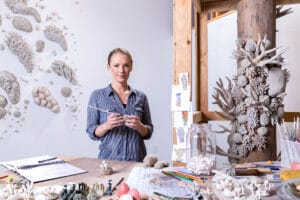
Courtney Mattison – American Artist and Ocean Advocate
Ceramic sculptor visualizing climate change through the fragile beauty of coral reefs.

UK
Ellie Black October 29, 2026
For Scottish sculptor Rob Mulholland, the natural world has been a lifelong source of inspiration, shaping both his artistic practice and his understanding of our place within the environment. Working across materials including steel and mirrored surfaces, he creates sculptures that explore the delicate relationship between humanity and nature, inviting us to consider the traces we leave behind and the world we inhabit. At Drumbeg Farm, within Scotland’s Loch Lomond & The Trossachs National Park, Mulholland is extending this vision through the Arcadia Sculpture Centre, a growing home for environmental art, artist residencies, and a renewed connection with the landscape.
Mood of Living: Where did you grow up? What do you remember most vividly about the place and environment where you spent your childhood?
Rob Mulholland: I grew up in Bishopbriggs, a small town near Glasgow in Scotland. It was on the fringes of the city, so we were lucky to have the countryside on our doorstep. I think the most vivid memory that I have is when my older brother and I went off on adventures in the local countryside, especially the local Low Moss woodland, where we would collect branches to build a den or gang hut, often foraging for blueberries as we never brought enough food! Thinking back, we used to walk and cycle for miles and spend the whole day in the woods without giving our parents any concern, and from memory I was only five or six years old at the time. Perhaps that is where my lifelong interest in, and connection to, nature and the countryside took hold.
MoL: What or who inspired you to become an artist? Was there a particular moment when you knew this was the path you wanted to pursue?
RM: From a very early age, I loved drawing, painting, and making things, just like most children do, but going into secondary school, things changed a bit. We would only have one period of art per week, so it was difficult to form a good body of work. This was back in the 70s, so imagine it’s different now with more focus on individual abilities. I also had that teenage angst of not knowing what I wanted and thought I wouldn’t be good enough to become an artist; it didn’t help that my careers advisor said I should work in insurance! After leaving school, I spent several years working as a retail manager for a large multinational company, which I enjoyed, but something was missing. Fortunately, I started drawing again, and slowly my creative side returned, and I re-found my passion for art that had been buried away trying to follow the corporate path. So at twenty-one I decided to give up my career job, nice new flat, and apply to art college.
Environmental sculptures
MoL: Where did you go to college, and what did you study? Did you ever consider a professional path outside of art?
RM: I applied for a foundation year, but had just missed the intake for Scotland, so I headed down to Wrexham, a town in North Wales, a great opportunity as the course had some very good tutors. We had the chance to try out different disciplines for a six- to eight-week semester. It was great to explore painting, three-dimensional design, sculpture, and printmaking, but in our final semester we had to choose one to apply for the full degree course. I decided on sculpture, partly because of my tutor Alan Bunkum and party because I realized that my mind works best in three dimensions.
I applied to join the second-year intake at Edinburgh College of Art and was accepted in 1983 to study sculpture; it’s such an amazing grand building with amazing studios that overlook the castle and has a real sense of history. Edinburgh is about an hour or so from Glasgow, close enough to visit my family, but also far enough away to let me discover and form my new identity as an artist.
As mentioned, I tried a different professional path after leaving school, but luckily realized that it wasn’t my true vocation, and now I can’t really imagine not being an artist. It’s become such an integral part of my life.
Mirrored Sculptures
MoL: What inspired you to focus on environmental art? How has your relationship with the natural world shaped the way you think about and create your work?
RM: I don’t think it was a conscious decision on my part. It just seemed to evolve as I developed my practice. I started making outdoor sculptures in my third year at Edinburgh College of Art and would use my old motorbike and drive out to woodland near Penicuik, spend the whole day there making sculptures, mostly from fallen branches and moss, photograph them and leave them standing to slowly change with the weather.
I would quite often collect bundles of twigs and strap them to the back of the motorbike to take them back to the college; I must have had people wondering what the hell I was up to as they passed in their cars!
It’s difficult to analyze what draws me to create environmental art; it’s very challenging both physically and mentally, and it appeals to my personality. It’s also about making work in the real world, in full public view where there’s nowhere to hide. People view the work in their domain, so they are not intimidated; they haven’t entered into a gallery space where they might feel that they have to conform. It’s raw and unfiltered outside, and asks the artist to fully embrace and connect with the natural surroundings.
MoL: What drew you to working with metal and steel? What do you find particularly compelling about these materials, both aesthetically and conceptually?
RM: I’ve worked with various materials over the years, from breakfast cereal to discarded drink cans, but steel has always been a constant source in my work. It’s the combination of practicality and aesthetics that draws me to steel. I love the strength of the material, the flexibility and endless shapes that can be formed. I switch between highly polished stainless steel, mild steel, and Cor-ten steel, a fantastic steel that rusts on the surface but retains its core strength. It all depends on the sculpture’s form and concept, and which material best conveys my ideas.
I love pushing the physical boundaries of the material. Important works to me, such as Skytower [ 2013 ], utilized the strength of steel to create a sculpture that looks as if it has been torn away by a sudden gust of wind. Each length of bent steel rod is carefully interwoven and welded together to support the seemingly random form as it blasts outwards from the controlled and ordered column structure of the tower. The sculpture represents my interest in order and chaos, exploring the foundational forces of nature, reality and existence, and the human trait to try and control our environment.
Mirrored Sculptures
MoL: Of all the work you have created, which projects are you most proud of, and why? Where can people experience these works?
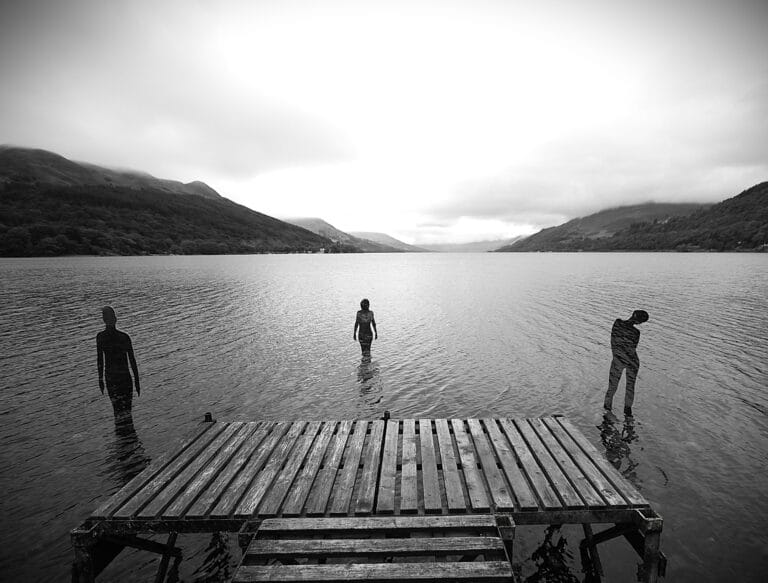
RM: This is difficult to answer. There are pivotal works such as ‘Vestige’, my first installation to use mirrored figure silhouettes, and ‘Skytower’ my first large-scale sculpture that depicts an imagined wind tearing the structure apart, that strongly resonate with me. However, I feel that I am still trying to make my best work, one which will completely encompass my thoughts and emotions, so it’s difficult to choose one. In many ways I believe that the journey as an artist is more important than the final destination. I’m not particularly precious about the physical works; time and the weather will slowly alter them, which is an important aspect of my practice.
People can see examples of these works in several countries. I have started adding maps to each project on my website to allow people to experience the work in person.
MoL: Tell us about Drumberg Farm, which you purchased in 2018 and which is located within Loch Lomond & The Trossachs National Park in Scotland. What first drew you to the property, and what makes this place so special to you? What is your vision for its future?
RM: Purchasing Drumbeg Farm was mostly down to my wife, Susan. We’ve been together since we met during my third year at Edinburgh College of Art; she’s my biggest supporter and most respected critic, so when she gives her opinion, I usually have to agree, even if it takes me a bit of time! I was at the point in my career where I had to find a permanent studio space. For years I had used old barns and rented workshops, having to move every few years when the lease expired, or the space became too small for the type of public art projects that I was being commissioned to make.
Susan suggested we sell up, move into a smaller house, and use the surplus funds to buy a place for me to work. We looked for nearly three years. We were based in the National Park near Loch Lomond, and farmers don’t normally sell here, so we were amazed when Drumbeg Farm came up for sale, only ten miles away from our house in the Trossachs, and in a great location. It had been a horse stable for many years, but the owner had moved abroad and wanted to sell, it was a large land area and was split up into three properties, luckily after several visits our offer was accepted for the main farm yard with numerous large sheds and outbuildings and twenty one acres of open meadow and ancient woodland.
Arcadia Sculputre Center
MoL: You are developing the Arcadia Sculpture Centre on the property. Tell us about your vision for the centre and what you hope it will become.
RM: We had a considerable amount of work to bring the buildings and main courtyard back to life. It had sadly been run down, mostly from a lack of maintenance, so it was important to get the basics sorted first: new electrics in the studio, toilet facilities, and a small office, a workshop, and a kitchen. Since then, we have built three cabins; two next to the woodland, which can be rented by the public looking for a few days’ escape in the countryside. They have full access to the sculpture trail, and we encourage them to visit the studio; it’s a really good way to introduce visitors to the center. The third cabin is reserved for visiting artists and is located at the back of the main studio.
We introduced a programme of funded artists’ residencies in the summer of 2023, which has been very successful to date. We run an open call each year, shared with Creative Scotland and the Royal Society of Sculptors, and it always attracts a large number of applicants. There’s a real shortage of affordable workspace, and Arcadia offers a unique opportunity to use the workshop and the woodland environment.
We welcomed our first graduate awardee from Edinburgh College of Art. Susanna Sergison has just finished her week-long residency. Susanna had a fantastic week exploring new ideas and developing a new series of work based on her time at Arcadia. We look forward to expanding this new graduate award next year and offering several new graduates the opportunity to stay and work at Arcadia.
This year we completed building a new house with two self-contained studio apartments on the hill overlooking the center. These new apartments will allow us to invite several artists to stay and work at the same time. Going forward, this offers us the opportunity to develop mini-symposiums. We’re keen to develop international residencies and hope to start this next year now that the new accommodation is complete. These new international residencies will include commissioning new sculptures for the trail, so artists will stay for up to a month to build their new work, that will be permanently installed here at Arcadia and become part of the art trail collection. I think that it’s important to have a range of work from different artists, all sharing the common purpose of celebrating contemporary environmental art.
The vision is to create an internationally recognized center in Scotland for environmental art. We’re realistic and know that this will take time, but we feel that we are already well on the way. The next step is to involve additional funding bodies and to seek out other international art centres to develop artist exchanges. We’ve set up a charity to run Arcadia with the hope that the project will continue to grow in future years. For now, we’re focused on making it all work and making Arcadia part of the Scottish artistic infrastructure, a place that will have its own unique identity.
Rob’s studio; Rob and his business partner and wife, Susan,
MoL: A major part of your work at Drumberg Farm involves restoring neglected woodlands and sustainably caring for the land. What does that process involve, and how do you hope it will create a haven for wildlife and biodiversity?
RM: The woodland was pretty neglected when we bought the farm. Large areas were overgrown, and the old clay underground drainage system was broken and choked. This meant that areas of land were boggy and often flooded. We wanted to improve the biodiversity, so after some research we decided to create three natural ponds. Experts say it’s one of the best ways to increase and sustain healthy biodiversity. Fortunately, the soil had a deep vein of clay, so we were able to dig out the ponds and allow the clay to do its magic! Within a few days, the ponds filled, mostly from water seeping through the top layers of moss and from a few drainage channels dug by our friend Gregor, a local farmer with an intimate knowledge of land that only comes from being born into farming. We visited each day, mostly checking the water levels, but on the third day our first tenants arrived: water boatmen, and then frogs laid their spawn a few days later. Within a few weeks, other insects arrived, and then, to our delight, dragonflies and damselflies started hovering over the ponds. All the ponds are now full of life. It was incredible to see how nature self-planted the ponds with water mint, Ragged-robin, Yellow flag iris, and Bull Rushes. In our imaginations, we pondered that a call had gone out to the wildlife in the area that there was a new pond in town!!
The main woodland takes quite a bit of work to manage. Occasionally we get very strong easterly winds which damage or completely fell some of our trees. It’s upsetting to see this as you get to know each tree individually. Part of our woodland is officially mapped as Ancient Woodland with some amazing oak trees. Only patches of this special woodland are now left in Scotland, so we feel quite a responsibility as guardians of this precious natural heritage. We are careful not to impose ourselves too much on this naturally perfect woodland, so to minimize footfall we designed and built a top-layered path following the burn that runs through the woodland. This was undertaken after we commissioned an expert to undertake an ecological survey to map rare species of flora and fauna. In early May, a splendid display of Scottish bluebells creates a purply blue carpet across the whole woodland floor. We are incredibly fortunate to have an abundance of wildlife in the woodlands, including red deer and occasionally migrating otters making their way down our burn that runs through the woodland. It’s quite magical to stumble across a huge red stag grazing on the bracken, look up at you for a spellbinding moment, then majestically trot up the hillside in a few effortless strides.
MoL: The Sculpture Trail brings your mirrored sculptures into the landscape, letting visitors see themselves reflected in the natural surroundings. What do you hope people feel or contemplate when they encounter your work in this setting?
RM: We have created two installations with my mirrored figures at Arcadia; one is a solitary figure placed in an area with ferns and moss, quiet and almost hidden. The other installation is a group of nine figures spaced out in the upper woodland, titled ‘Memory Fields.’ The mirrored figures almost disappear as you change your stance, reflecting the other trees surrounding them. They become a visual trace or vestige. I’m asking the viewer to consider their own relationship with the space, their fleeting memory and trace that they leave behind themselves as they wander through the woodland. As they walk past the figures, their own reflection is caught briefly in the figures’ mirrored surface, asking them to contemplate their personal and societal relationship with the natural environment. The installations are open to interpretation and invite the viewer to create their own narrative. As an artist, I am hopeful that they will engage with the work and develop their own thoughts.
MoL: What do you hope the next generation of artists will understand about the possibilities of environmental art, and about the role artists can play in encouraging greater awareness and care for the natural world?
RM: I hope the next generation of artists see the potential of environmental art and how it allows you, as an artist, the amazing opportunity to create and exhibit outside the confines of the gallery space. Environmental art integrates with society in both urban and natural settings. It celebrates art and culture and places work that can be seen on a daily basis. It becomes a landmark in its own right and part of the general aesthetics. If done with care and consideration for the given surroundings, it can enhance the visual experience. Artists generally communicate with their work; it has no language barrier and can provide a global platform for ideas and thoughts. I hope the next generation of artists will embrace this potential, forge new ideas, and inspire awareness for themselves and for all of us.
Skytower, Scotland
Photography courtesy of Rob Mulholland
Ceramic sculptor visualizing climate change through the fragile beauty of coral reefs.
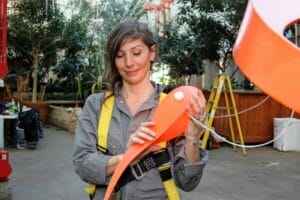
Robson is dedicated to transforming plastic waste into vibrant and intricate artwork.
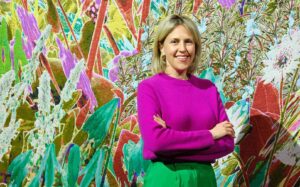
Dr. Ginsberg investigates themes of biodiversity, conservation, and the nonhuman experience to emphasize the importance of environmental advocacy.