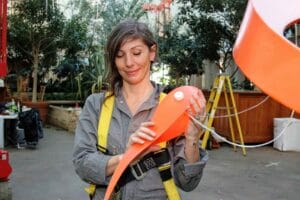
Aurora Robson – Environmental Artist and Founder of Project Vortex
Robson is dedicated to transforming plastic waste into vibrant and intricate artwork.

USA
Ellie Black October 12, 2026
San Francisco-based artist and ocean advocate Courtney Mattison transforms the intricate beauty of coral reefs into extraordinary ceramic sculptures that invite us to look more closely at the natural world and consider what we stand to lose. Drawing on her background in marine ecology and environmental conservation, she creates intricate, large-scale works that capture the otherworldly forms, colors, and textures of marine life, while revealing the growing fragility of these underwater ecosystems.
For Mattison, art is both a means of discovery and a way to inspire change. What began as a fascination with the ocean’s extraordinary creatures evolved into a practice that bridges science, sculpture, and environmental advocacy. Working with hundreds of individually sculpted ceramic forms, she explores the delicate balance between healthy, vibrant reefs and those transformed by climate change and coral bleaching. Her work has been exhibited internationally and commissioned for permanent installations across the United States, Europe, and Asia. At its heart, however, is a simple yet powerful idea: when we cultivate wonder and connection with the natural world, we become more invested in protecting it.
We spoke with Mattison about the experiences that shaped her practice, the connection between art and science, and the role creativity can play in changing how we see and care for the world around us.
Mood of Living: Where did you grow up? How did where you grew up shape your connection to the ocean and inspire your passion for its ecosystems?
Courtney Mattison: I grew up on the Pacific coast in San Francisco and was always fascinated by the mystery of what creatures inhabit the seafloor beneath the waves in my own “backyard.” As a child, I loved exploring tide pools and walking with my mom along San Francisco Bay, peeking into crab traps strung along the piers.
CMattison-ConfluenceOurChangingSeasV_ArtInEmbassies- See below for photo credits.
MoL: You pursued degrees that brought together science and art at Skidmore College and Brown University, followed by your thesis work at the Rhode Island School of Design. What inspired you to pursue this intersection of science and art? Were you drawn to both disciplines from an early age?
CM: My first high school marine biology teacher had contagious enthusiasm for the exotic forms of marine invertebrates, from nudibranchs (sea slugs) to crustaceans and corals. His passion inspired me to consider careers in marine science and begin exploring sea life through art. As a visual learner and an artistic student with a strong interest in marine ecology, it felt natural for me to explore marine invertebrate forms through sculpture. Skidmore College enabled me to pursue what they call a self-determined major, which in my case combined a full biology degree with at least one ceramics or sculpture class per semester, with advisors in both fields. The realization that I could use my artwork to change people’s minds and advocate for coral reef conservation led me to pursue an interdisciplinary master’s in environmental studies at Brown University, with half of my coursework and a member of my thesis committee at the Rhode Island School of Design Ceramics Department. My master’s thesis culminated in my first large-scale ceramic sculptural coral reef wall installation, Our Changing Seas: A coral reef story, which debuted at the US Department of Commerce headquarters in downtown Washington, DC, in 2011. Today I work full-time as an artist, and all of my work to date is informed by my background in marine conservation biology. Our Changing Seas continues, and this year I completed the tenth work in that series.
MoL: What first inspired you to focus your art on coral reefs and other marine life?
CM: By building representations of the marine invertebrates that I was studying in clay, I could better understand the complex structures of their anatomy and assemblages of colonial species. My artwork began from this personal sense of curiosity and evolved into a form of science communication and advocacy as I realized that it could inspire others.
2019-CMattison-OurChangingSeasIV -See below for photo credits.
MoL: When did you begin working primarily in ceramic sculpture, and what about this medium allows you to express your vision for preserving marine life? Have you ever explored other mediums in your work?
CM: It became apparent to me early on that ceramic has a brittle, stony quality that is shared by reef-building corals. To build a reef, stony corals precipitate calcium carbonate from seawater and accrete limestone skeletons in various forms in response to their species’ growth patterns and environmental requirements. Calcium carbonate also happens to be a common glaze ingredient. So, it feels essential that the medium of my work be ceramic. Furthermore, you can probably imagine how fragile porcelain anemone tentacles and coral branches would be, and real coral skeletons are similarly delicate. This shared sense of fragility is fundamental to the message of my work. I haven’t exhibited work in other mediums (yet), but I am excited to be experimenting with glass.
MoL: Your large-scale ceramic wall reliefs consist of hundreds of individually crafted pieces. Can you take us through your creative process from the initial idea and research to the finished work?
CM: I primarily work on commission, creating site-sensitive work for permanent or long-term installation. When designing a new sculptural wall work, I like to hear from the client what they have in mind and any details about the space where the work will be installed. I try to visit the space if possible, and research local connections to the sea and environmental issues relevant to the space where it will be installed. Then I sketch a design concept in ink and colored pencil and digitize it in order to superimpose it onto architectural drawings of the space. Once finalized, the design file is printed as a full-scale installation template and laid onto my studio floor, where I begin building each piece in relation to one another.
I hand-sculpt, glaze, and fire all of my stoneware and porcelain work in my San Francisco studio. I construct the main base pieces by coil-building hollow forms from a nice gritty, bulky stoneware clay and craft each branch, mound, and texture using simple tools like chopsticks and paintbrushes to sculpt and texture each piece by hand—often poking thousands of holes to mimic the repetitive growth of coral colonies. After pieces have had time to dry completely, I fire them in my electric kilns, being mindful to fire my kilns as full as possible to reduce energy waste. Individual pieces are finished and fired using a color palette of glazes that I’ve developed to reflect the vibrant tones and textures of healthy marine invertebrate communities, often juxtaposed against white glazes to emphasize the stark contrast of coral bleaching on reefs stricken by climate change. Upon glazing and firing each piece, I reassemble them at each step of the process and double-check that they fit onto my big floor template. My wall installations are often comprised of hundreds of individual pieces that mount directly to the wall using an array of hardware, which is meticulously planned out during the building process and attached once work is complete. Professional art handlers come to pack up my work and transport it to the installation site, and I love participating in installing my work in workplaces, hotels, museums, and homes around the world.
CMattison-Diving. See below for photo credits.
MoL: Your art brings greater visibility to the effects of climate change on our oceans while inspiring hope, action, and community engagement. What do you hope people feel or take away when encountering your work? Have you seen your art influence public conversation, policymakers, or environmental action?
CM: My artwork is the most natural and powerful way I’ve found to communicate ocean conservation issues and advocate for change. I hope that my work makes viewers feel a sense of wonder and curiosity that leads to understanding and action. Art has a unique power to shape how we perceive the world around us and our place in it. It can harness our imaginations, trigger emotions, and illustrate concepts that we have no other way to visualize. We protect what we care about, and we care about what we know and understand. Art can form personal connections between ourselves and natural beings or phenomena that can cause us to care about and act to preserve what we know and love. These personal connections are powerful because they can affect decision-making at all levels, from grassroots advocacy to corporate and governmental leaders.
Although my work is inspired by marine ecology and I’m versed in coral taxonomy and climate science, my main priority is to celebrate the strange creatures that made me fall in love with coral reefs in the first place. I take a lot of artistic liberties and often create “hybrid species,” combining forms, textures, and colors of multiple taxa into one piece. Swirling forms common in nature—from cyclones to seashells to waves and even spiral galaxies—inspire the compositions of many of my large wall relief works. I find these swirling designs to be quite powerful both conceptually and aesthetically, elevating reef forms off the “seafloor” and tossing them into space, with their fates determined by climate patterns and human decisions. Much of my work explores the transition that coral reefs are making from vibrant and healthy to stark white, with corals and anemones that appear sickened and bleached as a result of human-caused climate change. Coral reefs offer a haunting and stark visualization of climate change that I find incredibly powerful and important to communicate.
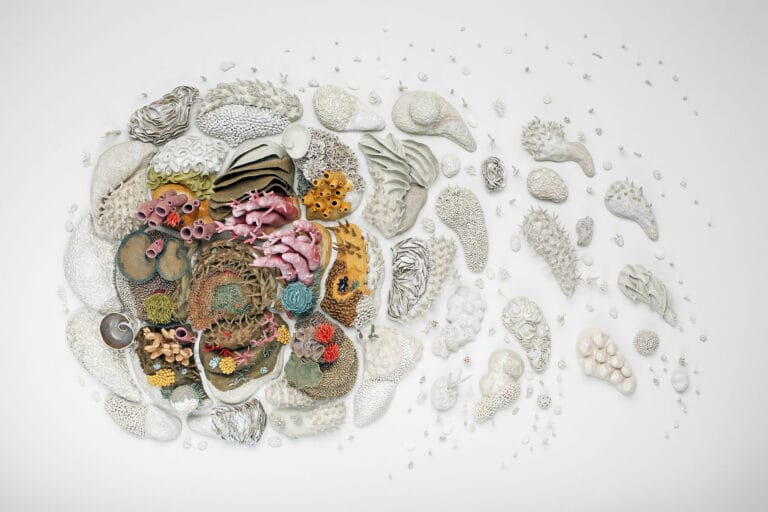
CMattison-OurChangingSeasIII – Tang Museum
MoL: What advice would you give to the next generation of artists who want to build a meaningful career while using their work to drive positive environmental or social change?
CM: Don’t give up! It’s easy to feel too small or powerless to make a difference. But we humans cause these issues (climate change, overfishing, pollution, etc.), and we have the power to rein them in. It’s important to remember that corporations have a tendency to make individuals feel guilty for causing climate change and other threats, yet the same corporations are responsible for most greenhouse gas emissions and are the ones who make the biggest difference. Our art can raise awareness and support corporations and policy leaders who understand that they are responsible and are working to turn things around.
Photography Credits:
Banner Photo: CourtneyMattison-Studio-©JeffMinton
Gallery 1: Photo 1: Courtney M. Sitting: Photo: Amanda Brooks for ArtinEmbassies
Photo 2: Courtney M. building: Photo ThadVickery
Photo 3: Courtney Mattison
Photo 4: Courtney Mattison
Photo 5: Installation Progress. Amanda Brooks for ArtinEmbassies
Photo 6: Installation Progress: Amanda Brooks for ArtinEmbassies
Gallery 2
Photos © Courtney Mattison
Gallery 3
Photos © BenHamilton-for-OceanicSociety
Gallery 4
Photo: ArthurEvans for Tang Museum
Robson is dedicated to transforming plastic waste into vibrant and intricate artwork.
Dr. Ginsberg investigates themes of biodiversity, conservation, and the nonhuman experience to emphasize the importance of environmental advocacy.
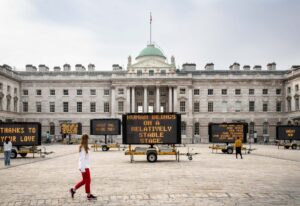
Environmental artist Justin Brice encourages others to take a critical look at the relationship between humans and the planet.