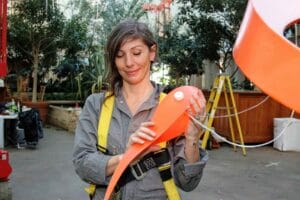
Aurora Robson – Environmental Artist and Founder of Project Vortex
Robson is dedicated to transforming plastic waste into vibrant and intricate artwork.

U.K.
Mary-Claire Harris September 8, 2025
Through her artworks, publications, and research, Dr. Alexandra Daisy Ginsberg deeply and purposefully unearths both modern perspectives around climate change and the futuristic consequences of it. She utilizes a combination of nature and technology in her work to suggest that the healing of our connection with the Earth is the key to preserving it. Her work with innovative mediums, such as gardens in Pollinator Pathmaker and generative adversarial networks in Machine Auguries, has led to the philosophical and scientific exploration of the climate crisis and the human relationship to it.
Dr. Ginsberg’s work has been displayed in institutions including MoMA in New York, The Contemporary Museum of Art in Tokyo, and the Royal Academy in London. She is the recipient of the World Technology Award – Design, the Dezeen Changemaker Award, and the London Design Medal for Emerging Talent.
Mood of Living: Tell us about your childhood- were you always drawn to both the arts and sciences?
Alexandra Daisy Ginsberg: Well, I always wanted to be an artist from about the age of three and then went off on a different track and decided that I might be interested in becoming an architect. At school, I studied both sciences and arts, because I was very split in the UK system, which is specialized very young. So, I was doing chemistry and maths, but then, also art and languages. I went on to study architecture because it was this amazing mixture of both. I didn’t actually want to be an architect, but it seemed like the best way to combine them in one degree, which is what it did. I still got to draw and go to history lectures in one course. I grew up in the countryside, so I was very lucky to have access to nature and parents who were profoundly engaged with engaging me with a love of nature. My dad had, at one point, a shiitake mushroom farm, so I spent some of my childhood picking mushrooms.
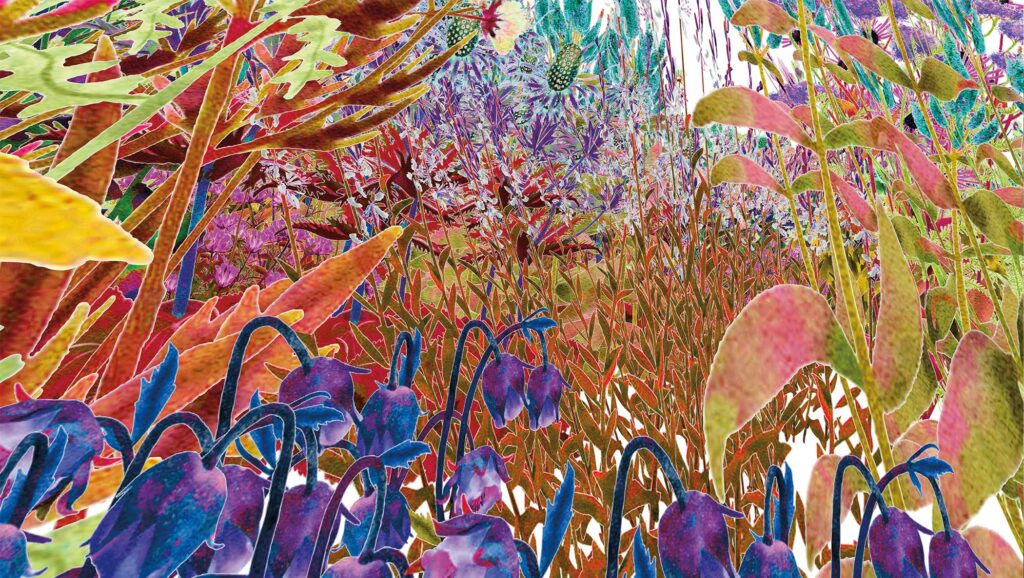
1. Pollinator Pathmaker in pollinator vision, 2023. Photography credits below.
MoL: Did your studies in architecture at the University of Cambridge lead you to research in fields like synthetic biology and biodiversity? Were there other influences?
ADG: No. I studied a very classical education for my undergraduate. And then I went off to work in urbanism, for London at City Hall, where Richard Rogers, the architect, was leading a unit in which we thought about 50 and 100-year futures for London. So suddenly, I had this concept of the future over me in that role as an assistant. And then I went off to study- I had a year scholarship to study anything, I was meant to be doing landscape architecture. Instead, I discovered technology. I ended up visiting friends at the Media Lab at MIT and saw a room full of robots, and through that, I found myself back in London at the Royal College of Art. There was a new master’s course that was looking at emerging technology, but through a critical lens, using design as the way to explore that. I ended up learning something about biotechnology and how these scientists and engineers were treating living matter as a design material, which really kicked me off in this direction.
MoL: After graduating from the University of Cambridge, you were a visiting student at Harvard, where you studied Animation, Film, and Architecture and Set Design. What inspired you to blend the mediums of film and architecture, and how do you utilize that knowledge in your work today?
ADG: For me, it was really just expanding learning skills that I hadn’t had enough time to engage with, and helping me think about what else architecture is and can be besides making buildings. There was a small amount of exposure I had to all these different tools and methods, yet this helped me think about what other ways that I could practice beyond making buildings themselves. I felt that didn’t match up with what I wanted to do. I wanted to have an impact.
2. Pollinator Pathmaker Eden Project Edition. Photography credits below.
MoL: What inspired you to pursue your Doctorate in Philosophy at the Royal College of Art? Why specifically Design Interactions?
ADG: Well, I spent a lot of time hanging out, in the anthropological sense, with all these synthetic biologists and designers. I was curating a research project where we had scientists, engineers, artists, and designers doing residencies around the world. And then it left me wondering – where am I now as a practitioner, what does it mean to be intervening upstream in the development of a controversial technology, and what do I need to go and do to understand what it is that I’ve done? It was very experimental, and I wanted to get some kind of framework around it. I needed some time to reflect on it to work it out. So I went back to do a PhD to make sense of what I wanted to do next in the art world.
MoL: Do you have a specific process behind your works? When starting a project, are you driven more by a certain problem or research topic?
ADG: I’m often very lucky to be invited to propose something in a competition. And then I somehow end up finding a way to turn it around. For example, with Pollinator Pathmaker, I was invited to propose a sculpture to bring attention to the pollinator crisis. We tend to think of pollinators just as bees, but in fact, they also include hummingbirds, bats, wasps, butterflies, and even some mammals. I didn’t agree with the brief to just make a sculpture about this – it would be more interesting and more provocative to make a sculpture for them. And that’s how Pollinator Pathmaker began. So then, I set myself the question of – what is a sculpture for pollinators? What would they see? What would they like? How do you even begin to think about the aesthetic world of an insect and their experience of that world? And that is often how I begin creating an artwork – give it a brief and then end up turning it around.
3. Pollinator Pathmaker Serpentine Edition. Photography credits below.
MoL: When it comes to sharing your ideas, do you find publications or exhibitions to be a more effective platform, and why?
ADG: Ultimately, I’m asking questions and telling stories about our relationship with the natural world, and asking why we treat it in the way that we do. Why do we feel divorced from nature when it’s what supports us? Why have we somehow separated innovation from conservation of the natural world, when actually the two things can’t be separated because we can’t live without an ecosystem supporting us? So, writing about it or making work about it, those things often overlap. Still, as a visual and multimedia artist, I’m interested not just in our brains, but in our bodies, specifically how a beautiful or difficult aesthetic experience has a transformational aspect on us. So making things that aren’t in words, that are experiences, that go through our eyeballs or through our ears or through our bodies, is also important to give us an emotional response. I think that physical and emotional responses are different and very important compared to what we get with words. Both are really powerful ways to tell stories.
MoL: In your works, is your main goal to find scientific solutions for environmental problems or to bring attention to the problems themselves?
ADG: I’m not a problem solver. I don’t think I can make the world a better place. I’m more interested in giving people who are engaging with what I’m doing agency, or an emotional change, or a way to think about something in a different way. Pollinator Pathmaker is the clearest example of something you can do. You can plant your own artwork, but that artwork is not going to solve the pollinator crisis; though if lots of people plant them, it’s definitely a good thing. More important is the process of engaging with it, of being able to, especially if you’ve never gardened before. If you don’t have a garden, it’s about coming together with a group of people at your school or in a community, fighting for that space, fighting for funding, and coming together to organize. But most important is spending time looking at nature as an artwork in itself. Then, because you’ve had that experience with Pollinator Pathmaker, you have to keep on looking after it. It’s an ongoing caretaking project. So, although Pollinator Pathmaker is different from what I’ve done before, it’s not the only way that you can challenge people or ask them to think about things differently.
MoL: Your talk Designing Nature discussed the key differences between “better” and “good.” How do you stay true to this philosophy in your research and projects?
ADG: I wrote my PhD about this word ‘better’ because everyone was getting very excited about making the world a ‘better’ place, but no one was saying what that meant. And what it meant was this very loose set of very different things to different people. With ‘good,’ there are moral rules that are generally agreed upon. Humans agree in a society about what is morally good or morally bad, not to say that all societies have it right. I’m not pretending that the choices that I make are ascribing from an excellently well-behaved moral place. We can all do ‘better’ in those things. But ‘better’ needs to be defined. So, the ways we behave as a society or what we have created laws around can be defined by the moral good. There must be more definition. It’s something that we need to constantly reflect on – whether you’re just trying to do better, or you’re actually focusing on that good.
4. Pollinator Pathmaker LAS Edition. Photography credits below.
MoL: Some of your works utilize AI to highlight climate change and humanity’s impact on the world. Do you believe AI to be a vital resource for designing and researching for a more sustainable future?
ADG: There’s an excellent book, “The AI Mirror,” by Shannon Vallor, who wrote beautifully about this, saying that the AI we have now is not the AI that we necessarily want to have. As an artist, I like to engage with AI in a critical way – I’m using it, but I’m trying to understand what it’s for and where the problems are. AI is not a harmless, aloof cloud. It is another organism on the planet – it’s using carbon, it’s drinking water, and it’s out of control. It’s an animal in itself that we’re creating. It’s very resource hungry, and at the moment, it’s being allowed to do whatever it wants, because nobody wants to fall behind. But the question is, what do we want from it? And who gets to control it? And whose future is being enabled or disabled by it? We created an artwork, Machine Auguries, where we reconstructed the dawn chorus using a generative adversarial network. It’s not because I think it’s a good idea to recreate the dawn chorus using AI, but to show that we can create a reproduction of it. And even if you create a reproduction of it, it’s not the dawn chorus. It’s just the sound of it. It’s not the complex web of ecosystems. So, we can have this incredibly impoverished experience of nature just by listening to a reproduction of things. But the real thing is outside. We should go and listen to it and hold on to it.
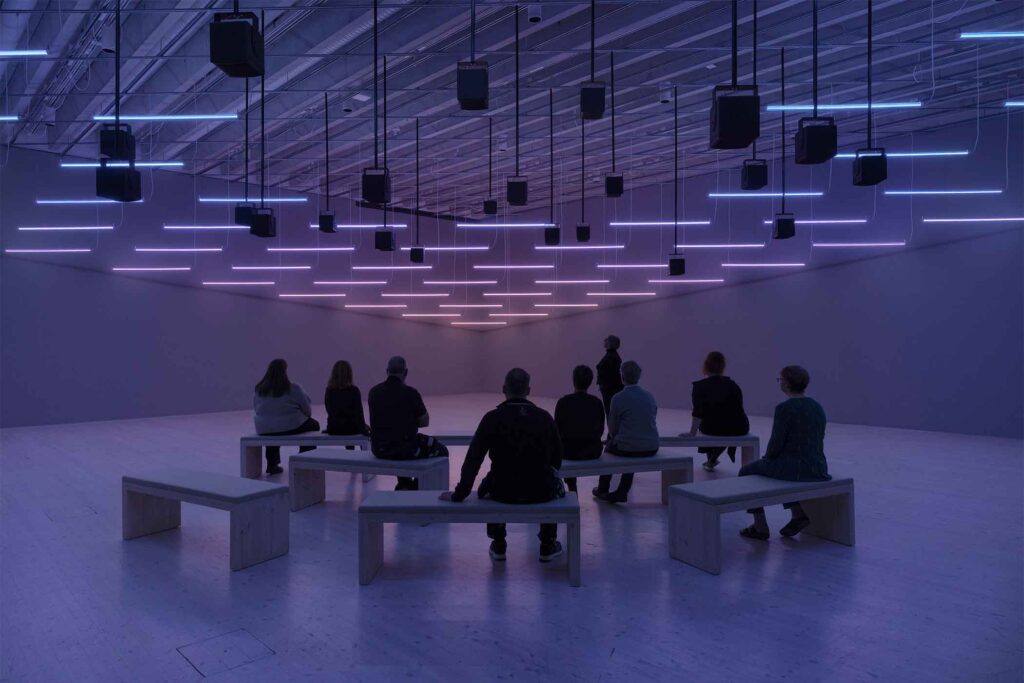
5. Installation view of ‘Machine Auguries: Umeå’ (2025) at Bildmuseet, Umeå, 2025. Photography credit below.
MoL: What advice can you give to someone interested in pursuing climate-focused research or design in today’s world?
ADG: All I can speak of is from my own experience – Pollinator Pathmaker was the result of feeling complete panic. I feel so overwhelmed by my love of the natural world. I experience fear on a daily basis, yet I just somehow get on with my life, living in a city. What small thing can I do that will have an impact? Saying – well, I found a way of telling a story and engaging people and joining in, and as a result, all these other people are joining in doing things alongside and around it. It’s not about solutions, it’s about agency.
Photography Credits
Banner Image: Photo credit: Thierry Bal. ©️Alexandra Daisy Ginsberg Ltd. Daisy in front of her 28-meter-long tapestry ‘Four Epochs of Paradise’.
1.Pollinator Pathmaker in pollinator vision, 2023. Photography courtesy of Alexandra Daisy Ginsberg Ltd.
2. Pollinator Pathmaker Eden Project Edition. Photography courtesy of Royston Hung. Courtesy of Alexandra Daisy Ginsberg
3. Pollinator Pathmaker Serpentine Edition 3a, 3b,3c Photography-Royston Hunt – Courtesy Alexandra Daisy Ginsberg Ltd. 3d Photography Courtesy Alexandra Daisy Ginsberg Ltd.
4. Pollinator Pathmaker LAS Edition
1.Installation view of Pollinator Pathmaker LAS Edition, 2023. Photo:
Anna Sophie Schwarz, Courtesy of Wall GmbH
2.Pollinator Pathmaker LAS Edition in the forecourt of Museum
Fürnaturkunde Berlin in June 2024. Photo: Sabine Bungert, Courtesy LAS Art
Foundation
3. Pollinator Pathmaker LAS Edition in the forecourt of Museum
Fürnaturkunde Berlin in June 2024. Photo: Sabine Bungert, Courtesy LAS Art
Foundation.
4.Planting of Alexandra Daisy Ginsberg: Pollinator Pathmaker LAS
Edition in May 2023, commissioned by LAS Art Foundation. Photo: Frank
Sperling. Courtesy of LAS Art Foundation.
5. Digital render of Pollinator Pathmaker LAS Edition in human vision, Courtesy the artist. © Alexandra Daisy Ginsberg Ltd
5. Installation view of ‘Machine Auguries: Umeå’ (2025) at Bildmuseet, Umeå, 2025. Photo: Malin Grönborg. Courtesy of Bildmuseet.
Robson is dedicated to transforming plastic waste into vibrant and intricate artwork.

Environmental artist Justin Brice encourages others to take a critical look at the relationship between humans and the planet.
Internationally recognized filmmaker Andrew Morgan focuses on telling stories for a better tomorrow for various film and new media projects.