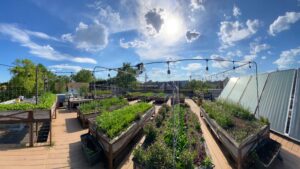
Uncommon Ground — America’s First Certified Organic Rooftop Farm
Founded by Helen and Mike Cameron, Uncommon Ground is America’s first certified organic rooftop farm.

USA
Onalee Duane May 21, 2021 — REVISED JUNE 2026
As one of New York’s most resourceful business owners, Camilla Marcus opened her restaurant West~Bourne in 2018, a zero-waste, LEED green-building certified restaurant governed by the philosophy of doing good through food. Born and raised in California, Marcus developed sustainable habits and environmental mindfulness, both of which shaped her eco-conscious business practices and commitment to creating a more equitable and sustainable hospitality industry. Marcus attended the University of Pennsylvania for her undergraduate education and later earned a law degree and an MBA from New York University. Despite transitioning from law to hospitality and entrepreneurship, Marcus stresses the importance of her education in her everyday life, made clear by her participation in the Independent Restaurant Coalition (IRC) and Relief Opportunities for All Restaurants (ROAR) in New York.
For Marcus, food is care, and to care about what we eat, where it comes from, and how it reaches us is to care about the land, its farmers, and the world. After closing its physical restaurant space following the COVID pandemic, West~Bourne transitioned online, selling food products sourced from regenerative farms and producers with traceable supply chains. The brand is deeply committed to regenerative farming, which promotes biodiversity, carbon capture and nutritional density in crops. The shop is committed to a mission to work toward solving the climate crisis through regeneration and transparency.
West~Bourne’s entire supply chain is plastic-free, using fully recyclable bottles, glass jars and biodegradable pouches to reduce carbon emissions. Plant-based labels are dissolvable, tamper bands are compostable and boxes and stuffing are recycled and reused. West~Bourne’s ethos extends beyond its own operations, partnering with organizations that share its environmental values. The shop works with EcoCart, a software platform that allows customers to make their shipments carbon-neutral at checkout and invites them to become active participants in combating climate change. To further offset its greenhouse gas emissions, West~Bourne partners with MAD Agriculture, a non-profit dedicated to regenerative agriculture, and contributes to The Garcia River Project, a Redwood Forest preservation coalition. Believing in food as a means of uniting, West~Bourne affirms that sustainability is a collective effort.
Mood of Living: With your educational background in law and business, what made you decide to go into hospitality?
Camilla Marcus : I’m passionate about food and I always cooked when I was a kid. I knew I wanted to go to culinary school from a young age, and I’ve always taken a generalist approach to my education and my work experience. Even amongst friends, I have a broad swath of people in my community and I always felt drawn to food as a universal language and connector. Even when I was in college, I cooked big dinners for people. I was very into the restaurants in Philadelphia, and growing up I’ve always felt so drawn to hospitality and the generosity, kindness, creativity, and drive of the people that work in it. When you travel, it’s the way you connect to someone’s heritage and home. It’s always a real magnet for me.
MoL: Was it a leap for you to jump into the restaurant industry?
CM: No, it was always where I found my people and my place. I knew I’d be in the industry in some capacity. I was figuring it out by trying a lot of different jobs to see where exactly I fit. I never went to law school thinking I would practice. Restaurants are the most regulated industry, so the truth is, I actually use my legal degree every single day. So much of law teaches you how to think objectively, how to be creative and flexible in how you look at things, especially in restaurants. To see how all these ecosystems really interact was invaluable.
MoL: Sustainability is one of our core values at Mood of Living, and it seems to be in your work too. How do you lead an eco-conscious lifestyle, and how did sustainability play a role in the creation of your business?
CM: Sustainability was absolutely at the heart and the origin of what West Borne was built for, it was our “why.” It stems from growing up in California and living much more integrated with the land and having that heightened sense of harmony with nature. Climate change has been discussed more in recent years. I had those sustainability values and important conversations growing up. When I came to the east coast for college, I realized what a bubble that was — and I began seeing a change in people starting to pay attention to climate change in a real way. Food is the most integral and most impactful part of that. The entire food system, seeing how hospitality plays a big role, learning new practices and how to cook at home, learning about ingredients and connecting that to farms — all this happens through the center point of restaurants and hospitality.
MoL: Where does your inspiration come from? How did you find inspiration for the re-focusing of the West Bourne brand?
CM: One of my biggest inspirations has always been travel, exploring other countries and other cultures and meeting different people. There is inspiration in every day but I’m someone who, to think outside the box, I have to be outside the box. I draw from a lot of different industries and from a lot of different types of people around the world. There’s always best practices and new ideas to learn from. I’m an explorer at heart, and when I travel, I see how much different cultures, backgrounds, traditions, and places handle universal issues differently. That’s where I learn and get inspired the most.
MoL: How did you come to be a founding member of Relief Opportunities for All Restaurants (ROAR) and the Independent Restaurant Coalition (IRC)?
CM: It came when the shutdown happened in mid-March. We quickly realized that a huge swath of people across the country were losing their jobs and businesses had no clue what was going to happen. I’m someone who believes in a village mentality — I’m not a private mourner, and I’m not a private anxiety experiencer. I’m the person who’s the first to call you and say, “I’m having a problem, are you too?” I’m not shy and I’ve got no shame in that regard. So, I started calling friends in the industry, small restaurant groups, big restaurant tours and saying, “I’m seeing this very scary cliff, and it seems like the government and the communities and the public don’t see what’s happening to us.” Lo and behold, there were a lot of people who felt the same way. I got pulled into the IRC specifically as a founding member. Similarly, with ROAR New York, myself and a handful of others said, why don’t we each email ten people we know, and within 24 hours we had 60 Restaurant tours across the city on a call. People think that we’re competitors and that we’re all so different, but we’re actually much more collaborative and much more the same than we give ourselves credit for. We’re in the business of taking care of people and caring about others. Coming together in that way felt very natural.
MoL: What do you see for the future of both organizations?
CM: I believe they’ve given a real, and hopefully lasting voice, to an industry that is constantly lumped in with small business. Restaurants are incredibly important to the cultural and social fabric of our communities. The future hope is that both the IRC and ROAR pave a more sustainable and more equitable future for this industry. This is and always will be a people business. Without restaurants and the people out and about at them creating that connectivity and electricity, New York City felt like Gotham. The goal is to increase and build awareness on how essential we are, and work together with the government and the public to really reorganize and restructure an industry to be much more sustainable and much more equitable and hold a place socially, culturally, and economically that it hasn’t been recognized for.
MoL: What advice would you give the people who want to make change in their communities, but are hesitant or don’t believe they can do it?
CM: I am a big believer in the power of every human to make an impact. I know that there’s so many signs in our world that tell us that’s not true, but every proof point that I’ve seen in my life says the opposite. You just have to put one foot in front of the other. We’ve seen this year, now more than ever, that one person’s choice and another person’s choice put together creates a tide change, like how a couple drops in the ocean can make a wave. I believe that companies, our government, and cultural norms, over time, shift where value is. I think you have to decide in your own life where you’re going to place value that will lead to structural change. Instead of asking “why?” ask, “why not do something?” There’s no reason not to do something, and that something can be as small or as big as you see fit. But I think it’s hard to justify doing nothing.
Photography courtesy of Camila Marcus
Founded by Helen and Mike Cameron, Uncommon Ground is America’s first certified organic rooftop farm.

In 2008, Kristofor Lofgren, president of Sustainable Restaurant Holdings Inc., created Bamboo Sushi: the world’s first certified sustainable sushi restaurant.

Dig Inn is a chain of restaurants that focuses on healthy, fast, and farm-to-counter eating.