Dr. Alexandra Daisy Ginsberg – Artist and Environmental Advocate
Dr. Ginsberg investigates themes of biodiversity, conservation, and the nonhuman experience to emphasize the importance of environmental advocacy.

U.S.A
MARY-CLAIRE HARRIS 12/01/2025
Born in Toronto, raised in Hawaii, and now based in New York, Aurora Robson has been exposed to both the beauty of nature and the consumer-oriented economy that threatens to destroy it. She studied art history and visual art at Columbia University, where she engaged with artists, professors, and philosophies that continue to guide her work to this day. Robson also founded Project Vortex, a global collective of artists, architects, and designers who work to transmute pollution/post-consumer materials into artwork.
Through a process she refers to as “serious play,” visual artist Robson critically engages with post-consumer waste in order to give it a second life as meaningful and beautiful artwork. Robson investigates the destructive and often chaotic aspects of plastic pollution and societal attitudes toward it through sculptures and site-specific installations, using methods such as weaving, sewing, welding, and printing. Her art is also described as a meditative practice, one in which she reaches toward “rational optimism” and “radical acceptance” in a world seemingly surrounded by negativity and dissension.
Robson has received many awards, such as the Pollock-Krasner Foundation Grant, the Lincoln/TED Re-Imagine Prize, and the Brattleboro Museum of Art Award for Service to the Arts and Humanity. Her work has been displayed or installed in numerous institutions, including the New Gallery of Modern Art, the Winter Garden Gallery at Brookfield Place, and the Halsey Institute of Contemporary Art.
Mood of Living: Tell us about your childhood- have you always expressed yourself through art?
Aurora Robson: I grew up in Hawaii, on Maui, which is often described as paradise on earth, but it was also a particularly challenging experience for me. My family life was complicated; my father was in and out of jail, exhibited sociopathic behaviors, and created a very stressful environment in which to grow up. On top of that, we were living in Hawaii illegally (Canadian citizens). My dad had been arrested in Canada for smuggling drugs, so he fled with us to Hawaii to avoid incarceration. I would get my clothing from the town dump, while he drove around in a Jaguar and wore velvet suits and alligator skin boots. All this took place with a backdrop of plumeria, hibiscus, passion fruit vines, the Pacific Ocean, mangos, papayas, guavas, eucalyptus forests, volcanoes, beaches, sugar cane fields, pineapple fields, etc. Homelife aside, I grew up as a minority (caucasians are the minority in Hawaii), and I went to some notoriously tough public schools for minorities. So, while I was surrounded by breathtaking beauty and sensuality, I was usually somewhat terrified, alienated, and lonely. As a result, I found art early on. Initially art presented itself as an escape from the parts of my reality that I had a hard time with. In art making, I had agency. I was free from judgment. I wasn’t creating art for others, but was doing it because I needed to. I used whatever was available to me, old magazines, crayons, markers, scraps, and bits of any old thing. Making art was a place where all the wilderness of my mind and spirit could be reflected. My father, despite all the attributes I already mentioned, had an appreciation for art and thought the life of an artist would be the most liberating life one could have. This is all part of what sparked my interest in art.
Installations – See titles below
MoL: What influenced you to pursue a career in the arts? Did anyone or anything specifically inspire your vision of art as something that could be sustainable and transformative?
AR: To be honest, I resisted pursuing a career in the arts for quite some time. I skirted around it because I was afraid of the lack of stability that being an artist seemed to entail, unless there is a financial support system in place. Eventually, I succumbed. The most influential artists to me when I began my art practice were Tom Friedman, Tara Donovan, Lee Bontecou, Judy Pfaff, Tim Hawkinson, Janine Antoni, Louise Bourgeois, and Agnes Denes. At my most impressionable stage as a young artist in New York, these are the artists who did work that spoke to me most directly about transformative, radical approaches to art making and about freedom from traditional materials for art making, both of which appealed to me.
A deep love and respect for nature, which resulted from growing up in Hawaii, where nature dictates life above all else, was a major driver for the dedication to sustainability in my practice. In addition to visual artists, I was influenced early on by Buckminster Fuller, Carl Jung, and Joseph Campbell. Fuller for his environmental perspective, systems theory, and ideology, Campbell for his comprehensive spiritual, social, and cultural writing, and Jung for his philosophy.
After years of supporting other artists with their work, I finally succumbed to being a practicing artist myself, mainly because I felt an emptiness creeping into my life as I became more successful in other fields and felt a pull to a studio practice that I couldn’t ignore. (“What you resist persists.” – Carl Jung). As I saw a more traditional, safe career path open up with guaranteed income and benefits, I suddenly felt so empty and trapped that I finally found the courage to jump ship and try my hand at being an artist full-time, and now, twenty years later, I have no regrets.
MoL: In what ways did your experiences at Columbia University shape your perspective on art, as both a professional pursuit and a personal passion?
AR: Columbia was pivotal to me because it gave me the opportunity of direct engagement and learning with artists like Kiki Smith, Jon Kessler, and Tomas Vu Daniel as well as the opportunity to take classes from brilliant art historians and writers like Rosalind Kraus and Benjamin Buchloh. I had an insatiable curiosity about art and art history, and also became enamored with philosophy while I was there. Studying at Columbia gave names and context to my impulses as an artist, which helped me find a sense of direction for my work. It also did wonders for my confidence. Prior to Columbia, I was a high school dropout (with a GED) and was working as a welder. I had my New York State certification for metal welding and was working on job sites and film sets. I had a major inferiority complex due to my lack of formal education, so excelling in academics at Columbia helped repair my self-esteem and taught me to respect myself and appreciate my ability to overcome obstacles.
Sculptures – See titles below
MoL: What is the process behind obtaining the plastic you use for your work? Is it ever challenging or limiting to design with found materials?
AR: Collecting the material is the easiest part of my process. There is a hyperabundance of it, which you don’t really notice until you start looking for it. For some projects, I need specific chemical compositions of plastic, so I will collect them in different ways. For example, I’ve connected with people who are collecting PET bottles for redemption. You often see folks with shopping carts in urban settings doing this. I’ll ask if I can pay them double or triple what they would receive per bottle at a redemption center to collect the bottles for me instead. This way, they get a better wage for this work, I get materials delivered to my studio, and the surrounding city streets get cleaned up. I also sometimes work with clean-up organizations that are committed to removing plastic pollution from rivers, parks, oceans, shorelines, and roadsides, so I use the material they collect and try to create work for the community they are serving. Additionally, I have worked directly with recycling centers and transfer stations as well as corporations and communities to selectively collect materials of various types. Since we are all using so much plastic every day, it is never a problem to acquire the material. Fortunately, at this point, unlike when I started over twenty years ago, most people recognize that we have a big problem with plastic pollution. In addition, people are usually happy to collect material for me if I need a certain type because anyone with a conscience feels unhappy about how little they feel they can do to combat this massive beast of a problem. I reach out to my own community schools, libraries, or community centers to help with collections and enjoy the enthusiasm I usually find. Some people send me unsolicited post-consumer plastics that they don’t want to see ending up in the waste stream, so I keep these materials until I can use them for a project. The only problem I run into with materials is that I don’t have an aircraft hangar to store everything in. Now that I don’t live in the city (NYC), I have fewer issues with storage.
MoL: Why and how did you found Project Vortex? Is it difficult to find like-minded artists who are focused on sustainability?
AR: I founded Project Vortex because, as I continued working with this material, I became increasingly aware of how insidious the plastic pollution problem is for all the living creatures on this planet and about how little is actually being done. When I started, I didn’t know that the main ingredient in plastic is petroleum, that plastic is a very profitable and disproportionately cheap byproduct of the fossil fuel industry. Once I realized how big a monster plastic pollution is, I became both terrified and determined. I figured there must be other artists out there doing thoughtful, innovative work with this material, and that we should connect so we can support each other to have a bigger impact. There are many more artists than those who are in Project Vortex doing great work, and I find more all the time. I don’t have enough hours in the day to reach out to them all, but I am inviting new members and accepting submissions frequently and curating two more exhibitions of Project Vortex artists in New York in 2026/27. There is no shortage of material or amazing artists, and thankfully, now there is a lot of momentum.
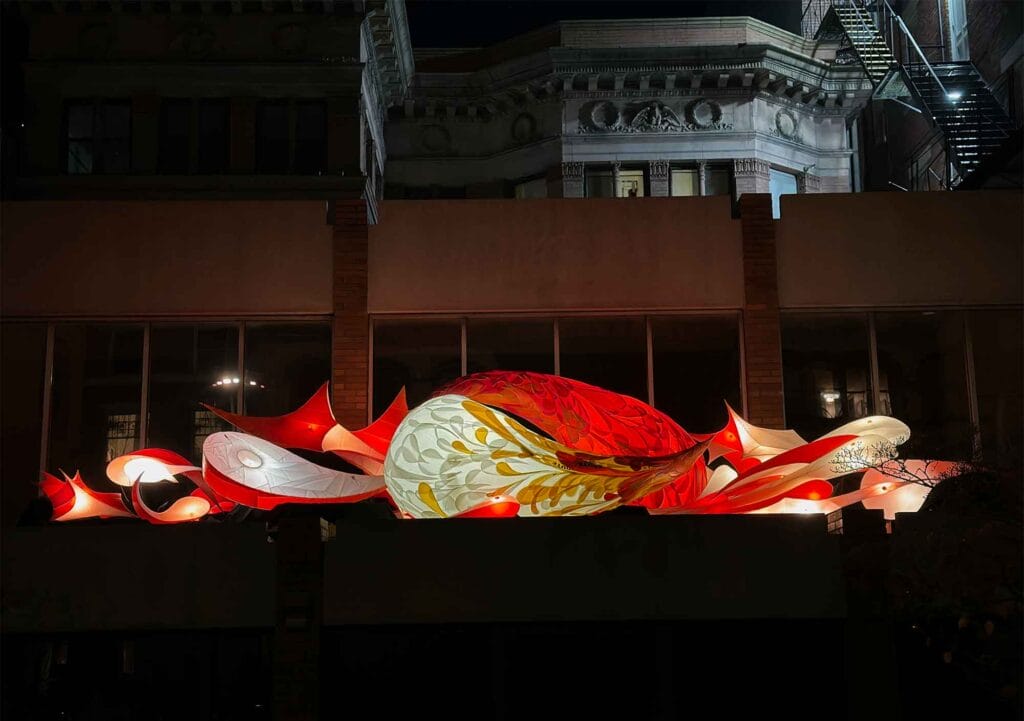
Installation : EOS
MoL: Tell us about how you develop your works from concept to finished product.
AR: The first question I ask myself when conceptualizing a new work is: What do people need to see here and now? This way, I have a purpose that is greater than my own feelings or needs, which is the only way I really enjoy making anything because it creates a conceptual subtext of service, in addition to being of service by sequestering toxic material into art. From that point on, each project is different in terms of process. Also, sometimes there is no end product; rather, just an ephemeral experience. But, being an environmentalist, I always start by looking at the context, the environment in which the work will ultimately live, and if that is unknown, I start by imagining an ideal destination or location for the piece so that a home for this homeless material can eventually be found.
Since I start by honoring the exterior, the world outside of my mind and body, with what emerges from inside my mind, I always think my process is similar to the impulse to water a plant; it is a loving act of caring and slowing down to notice what needs to be done and how to best be of service to life itself through the work.
From that point on, my process changes depending on the scale and nature of the piece. If it is something smaller than me, I can usually just dive in; but if it is larger than me, I do a sketch and create a model, either digitally with 3D modeling software, or out of cardboard, clay, or whatever materials might be most suitable for the scale of the model. It is important to make scale models for larger works so that you can factor in all the aspects of the work when it is on site and for it to be transported. A lot of the larger work I have created was done in sections, so it can be transported in a modular fashion. Then I collect material by any means necessary, clean it, sort it, and set to work if it is to be hand manipulated sculpture – if it is going to be 3D Printed out of upcycled (post-industrial) plastic, it is a different process, sometimes preparing files by using a high resolution 3D scanner and other times simply designing in 3D modeling software.
Wall Reliefs – See Titles Below.
MoL: What has been your experience with balancing a career in art with a family? What advice can you give to those wanting to follow a similar path?
AR: It has been extremely challenging, but 100% worth it. The most meaningful things in my life are my family and my work. Every day, I am so fulfilled and grateful that I have a purpose and sense of belonging as a result of having a family and having a full-time art practice. I see the way life beats people up who don’t have a sense of purpose or feeling of belonging, and that is heartbreaking to me. I feel it is our birthright to be able to pursue and explore our passions and interests. So many people don’t find a way to do that until they retire – there is no greater tragedy in my opinion.
That said, it was incredibly hard to be away from my daughters when they were little, so I avoided artist residencies until they were older, unless I could bring them with me or negotiate terms to see them frequently enough to not miss anything major in their lives or development. The impact that having a family has had on my ability to network during the earlier part of my career was formidable. I think that if I had gone to graduate school, which I was on a path to do but had to pivot due to health and life circumstances, my network would have been more established before having kids, which would have been advantageous. I recommend it to any artist considering a similar path.
When I became pregnant with my second child, I was still living in Brooklyn, and quite a few collectors and galleries basically ghosted me when they found out because they thought I was making a big, audacious mistake having a second child. At the time, it was practically unheard of for women artists to have children if they wanted to be “taken seriously”. I didn’t want my first child to be an only child, especially because my older brother has been such a godsend in my life.
The hardest thing for me is overcoming the feeling like I am never enough as a mother or as an artist because I am and always will be divided between these two loves, and that they both require so much attention to do a good job at. As a result, there is little time for anything else in my life. I think subsequent generations of women artists are and should be finding it much less daunting, since the power of women artists is becoming more apparent in the art world, and norms are changing. My biggest piece of advice is, if possible, to have children with a devoted partner who is invested intellectually, spiritually, emotionally, or otherwise in your success and who will respect your work, be honest with you, and discourage you from ever giving up. It is a long game that requires stamina. Carving out time to care for yourself is essential to maintain both with any grace and skill. I have been extraordinarily lucky to have an incredible partner who is a great father, and both my harshest critic and my biggest supporter.
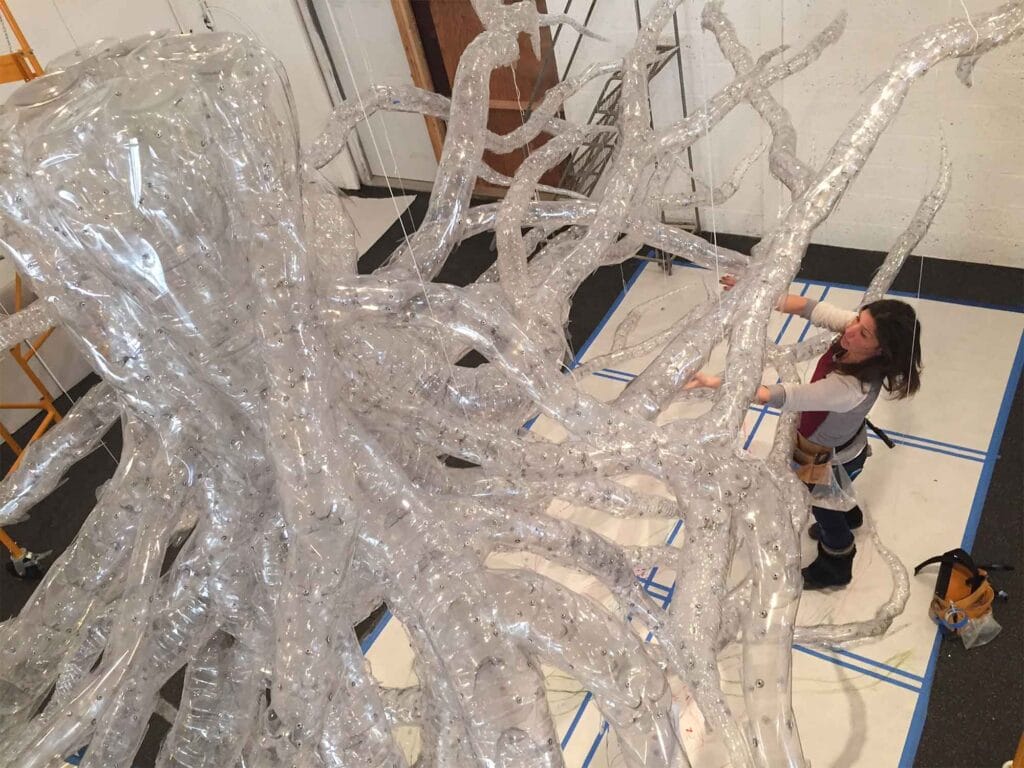
Aurora working on Root System Installation
MoL: I love the idea of “serious play” in your practice – is it ever challenging to remain positive and curious in a society that can often be negative and close-minded?
AR: It is always challenging. But I’ve always loved to challenge myself, so that is not a problem. Plus, usually, there is a way to navigate away from negativity, or to compartmentalize it, or zoom out and see it for what it is, which is typically rooted in fear, which is the basis for hatred, which is a dull and boring emotion. Sometimes negativity happens because someone needs a snack or a nap, or a hug. If I can help with any of those things, I do, and sometimes negativity just seems to come out of left field. Jealousy is a bear that shows up from time to time. I also will typically laugh a lot when things get preposterously difficult – it is a survival mechanism I developed early on with my mother and brother. However, all my smartest women friends know that if you don’t laugh when things get dark, you will likely cry, so it is wise to opt for laughter. Life is just bizarre and ridiculous in so many ways. Taking things too seriously when the course of the future can change on a dime is shortsighted and unpleasant on top of it. Staying grounded in the present moment is a good weapon against negativity as well. There is enough bad news to go around; you can refuse to consume a lot of it, since a lot of it isn’t real anyway. Whatever is real, that you can do something about, is all that matters. Allowing yourself to wallow in darkness, where you can’t see anything, except your own internal demons, who thrive there, is a complete and utter waste of time. I love time. I don’t have any interest in wasting a moment of mine or yours. So, I just focus on enjoying the process, which is often very hard, but also a tremendous amount of fun. It probably wouldn’t be worth doing if it were easy.
MoL: You’ve stated that your work is often a translation of recurring nightmares you had as a child, and compare it to the “toxic waste nightmare” of plastic. How are you able to take these dark, negative things and transform them into something wonderful and sustainable?
AR: The convenient thing about the recurring nightmares I had is that they were curvilinear and amorphous. This leaves lots of room to identify correlations between their formal structure and various forms found in nature, like fractals, plants, cells, celestial bodies, vines, vessels, branches, synapses, and so forth. Being in nature is always a huge help to the transformation process, as transformation is everywhere in nature. You see life emerge from death over and over (fungus, for example). But also, I employ a conceptual technique that basically prescribes finding opposing qualities and implementing them. So, if garbage is dirty and chaotic, I aim to make it into the exact opposite: clean and organized. Balanced and composed. If it is unloved, I love it until it becomes lovable by being loved. It is simple, foolproof, and very enjoyable because it always changes since the material is always changing. (A Poland Springs bottle, circa 2002, is very different from a Poland Springs bottle today, for example). It is like overcoming something new every day in my studio, which is a great way to boost morale. I wish everyone had something like that to help them get through their days – an activity that is achievable, allows you to feel effective at making something better. Anything. With visible evidence. It is like mana.
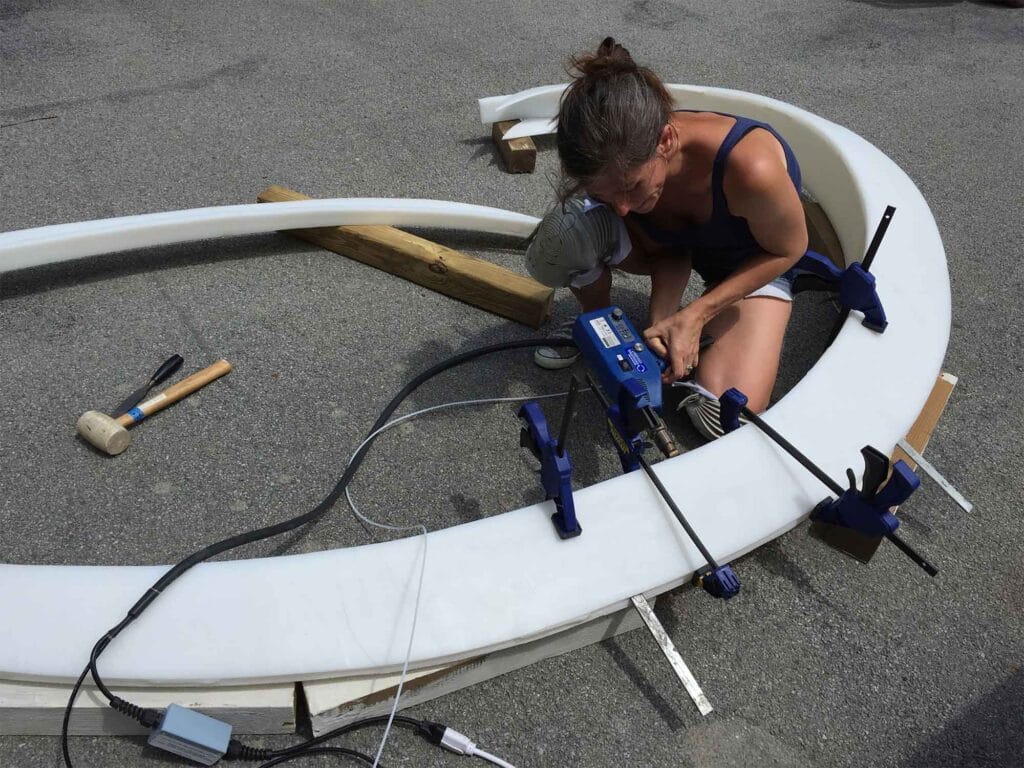
Aurora welding plastic debris
MoL: What role does your art play in taking on the issues we face today, including climate change, war, and social justice? Do you feel that your work inspires hope for a better world?
AR: It is a radical act or decision to remain hopeful sometimes, even more so to remain happy, no matter what. I have a mantra that I often use: “Happy Anyway”. It is very powerful and not always accessible to me, but repetition creates neural pathways that lead to very different outcomes and experiences. It is very effective with humans. We can convince ourselves of all sorts of things, and change ourselves on a cellular level as a result. So, maintaining my own sense of rational optimism is something that I know is contagious, and it alone directly addresses all sorts of issues, including climate change, war, and social justice. When people are at peace with themselves, they do not start wars. When people are “happy anyway”, they do not rape the planet of natural resources and contribute grotesquely to climate change through overconsumption or lack of producer responsibility, etc. People who are at peace with themselves seek to create more equity and justice for everyone they encounter. It is counterintuitive because many people think that you have to involve yourself in a fight to make it stop, but you really have to perpetuate peace in a very different way for it to be meaningful and lasting.
My work is designed to be powerfully peaceful, unwavering, and focused on solutions. I know that my work is worth doing, not just for myself but for all the living creatures, and that my initiative with Project Vortex is something I can be proud of because it inspires hope. There is a lot of comfort in knowing that there are so many brilliant people out there doing things to make life better for all humans! Project Vortex helps remind people of that and to see past the circus and hype and brainwashing that takes place and is being fed to us through various media channels. Helping people find ways to find their agency and power, to see through the chaos and static, and for them to then use their power to create more balance, equity, harmony, and reverence for all life.
Also, the material itself is clearly a big part of the message; it is called matter because it matters, so what you work with is just as important as what you say with the work you do. Kind of like looking at your closet or your fridge. What are you consuming in your life, and what are you consuming in your work? Are you using a lot of paint in the studio? Or a lot of garbage? What feels better and why? I think that is part of what is so compelling about Project Vortex. It is a compendium of people who are walking the walk and actually getting their hands dirty to make changes happen. We offer a meaningful alternative. Sure, we could continue to mine the earth for expensive traditional materials, or we can just use the stuff that is already here, the stuff that nobody wants, the stuff that we are stuck with for the time being, to create value where there is a deficit and to exercise our creative muscles. This shows that being an artist can be a symbiotic way to be of service that is accessible to everyone. What I mean by this is that my work in the studio and with Project Vortex definitely inspires hope, but maybe more importantly, I think it inspires action.
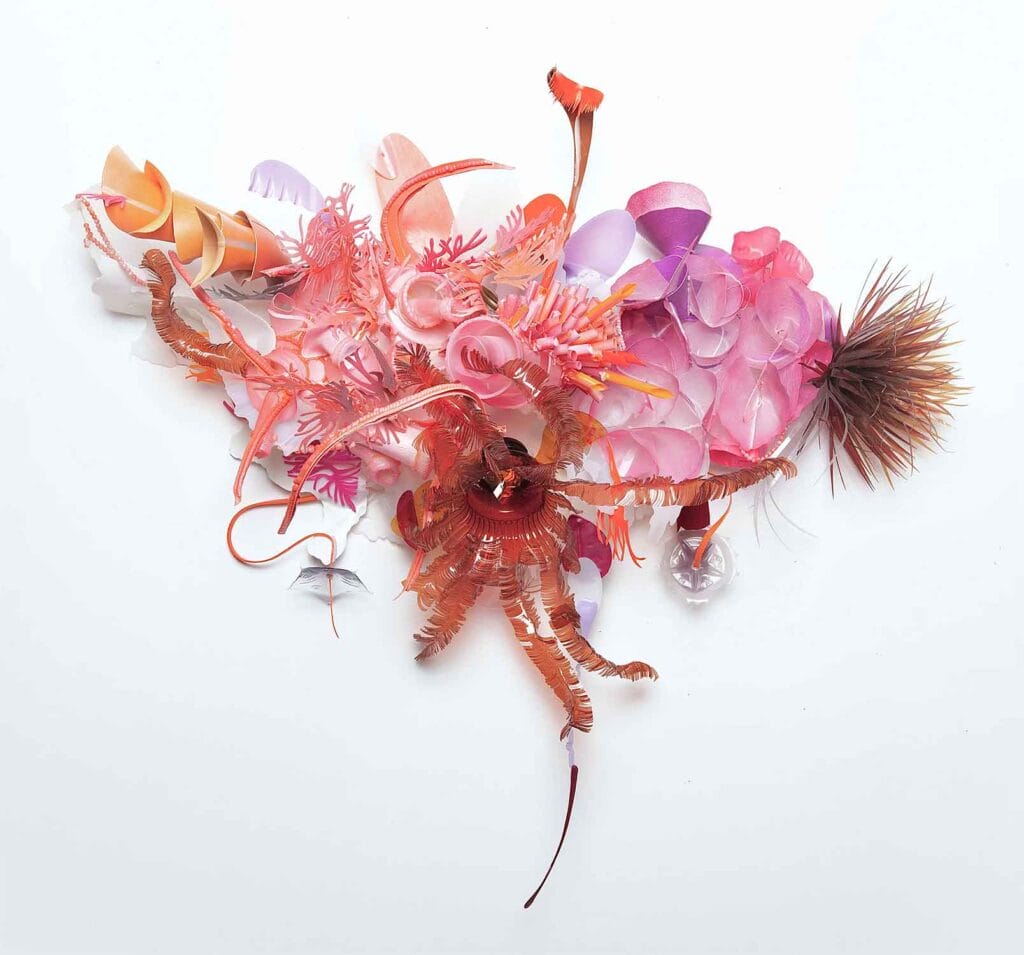
A Fine Romance – Wall Relief
MoL: What advice can you give to someone interested in a career that prioritizes sustainable art and design?
AR: Place what the world needs to see above what you feel like expressing. Find a local source for your materials or topic, and involve your community if you can. Trust yourself, make room for yourself in your practice, don’t let anyone steer you away from what you believe in, and don’t compromise your vision. Play. Assess and reassess your motivation. (Usually, it is either love or fear that is at the root of our motivation. The second you suspect it might be fear, stop, breathe, and start over when you are ready to allow love to motivate you.) Don’t be a “Debbie Downer”. Be pragmatic. Think about the long-term impact of what you are doing, not just the immediate outcome. Examine and re-examine each of your decisions, lead by example. Don’t preach. Do research, focus on, and stay up to date on sustainable innovation so that you can be a part of that dialogue or at least know what progress is being made. If you only focus on the devastation, it will steal your energy and momentum. Each time you find success in your work, help others, and also invest and reinvest in your work and yourself, so that you have adequate fuel and energy to keep going and growing your practice. Always explore little inklings and ideas that pop up; you have them for a reason. Honor them because that is where creative solutions come from. Practice forgiveness and acceptance for yourself and others. Do not make people feel bad about themselves for not being perfectly sustainable in their lives or work. Care for yourself so that you can care for others. Lead by example. Everything is contagious, and welcome to a meaningful life.
Installation Titles
1) Lover’s Spat
2) Be Like Water
3) Plant Perception
4) Quality of Mercy
5) Quality of Mercy
Sculpture Titles:
1) Updrop
2) Pick of the Litter
3) Kamilo
4) Everything All At Once
5) Pick of the Litter
6) Amygdala
7) 88%
Wall Reliefs Titles:
1) Whirled
2) They Knew
3) F**k New
4) Eva
Photography and video courtesy of Aurora Robson
Dr. Ginsberg investigates themes of biodiversity, conservation, and the nonhuman experience to emphasize the importance of environmental advocacy.
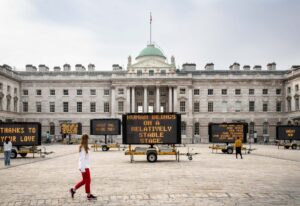
Environmental artist Justin Brice encourages others to take a critical look at the relationship between humans and the planet.
Internationally recognized filmmaker Andrew Morgan focuses on telling stories for a better tomorrow for various film and new media projects.