
Alan Barlis – Founder and Principal of BarlisWedlick Architects
A pioneer in Passive House design.
Championing architecture’s potential to create an equitable and sustainable future.

U.S.A.
Eden Pela Sept. 10, 2025
In the desert terrain of Taos, New Mexico, Michael E. Reynolds—one of the most influential sustainable architects in the United States—has spent more than five decades reshaping the future of self-sufficient living. Founder of the global architectural firm and training center, Earthship Biotecture and Academy, Reynolds began developing off-grid ecosystems in the 1970s that harvest water, grow food and regulate temperature naturally throughout the year. Unlike conventional sustainable designs, his Earthships are built from unconventional materials—earth-packed tires, cans, and bottles—giving form to structures that literally rise from society’s waste.
His work has been featured in Architectural Digest, the BBC, Cultured Magazine, PIN-UP Magazine, the CBS Early Show, the television series Stephen Fry in America, and podcasts such as How 2 Build Green. He also starred in the 2007 documentary Garbage Warrior, which chronicled his groundbreaking and controversial career. That same year, he championed the New Mexico Sustainable Development Testing Sites Act, a piece of legislation that permits experimental off-grid housing prototypes such as Earthships beyond conventional regulatory limits.
Reynolds prioritizes function over aesthetics, often producing homes that embody a raw, postmodern—sometimes dystopian—style. Yet his philosophy has profoundly influenced the conversation around sustainability and design. Today, he continues to refine his visionary structures while teaching a new generation of students at Earthship Academy how to build self-sustaining homes and embrace a way of life rooted in resilience, independence, and harmony with the planet.
Mood of Living: Tell us about your childhood—was there anything that influenced your passion for sustainability and architecture?
Michael E. Reynolds: There was my father—he saved everything. He saved many jars, bottle caps, and cans, which he figured were too good to throw away. It made an impression on me, I suppose, because now I see those same things, and I use them in buildings—tires, bottles, cans, and cardboard. My dad was also a builder for a while. I helped him dig and build a basement under our house by hand. And so, from the time I was 12 years old, I was sort of in the construction business, helping my father. And then, he went on to become a milkman, which didn’t earn him much money, so we were poor. Those things have affected the way I think today, which I’m happy about, because it puts me in the mindset of trying to reduce the amount of stuff we throw away. We live in a throwaway society. Everything that is made today, from furniture to equipment, is made to wear out and then be thrown away in a dump. I’m using a lot of things that would otherwise go into the dump, such as bottles, cans, tires, and cardboard, and repurposing them to make buildings. I’ve been doing it for decades. These kinds of things we throw away are better than most of the stuff we buy.
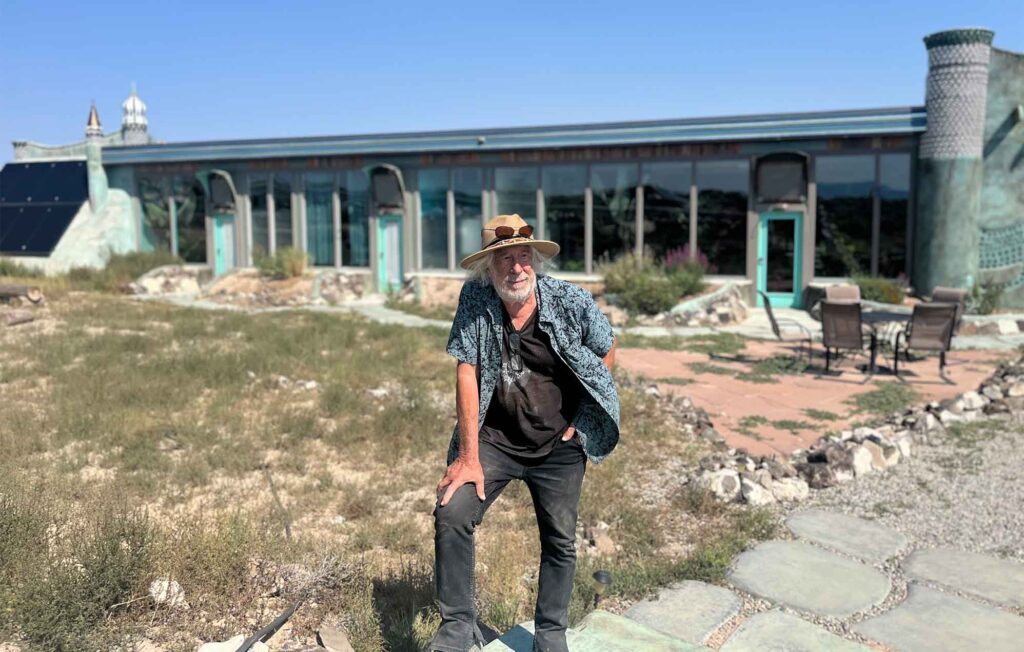
Michael Reynolds
MoL: Where did you study? Were there any mentors or people who guided you along the path you’re on today?
MR: I got my architectural degree from the University of Cincinnati. I observed when I was 20 that the architecture that was being taught was not going to solve the problems of the future. I began thinking in other directions. No architect there was a mentor, because they were all being architects in the conventional sense of the word.
My mentor is a tree. A tree takes care of itself. It doesn’t need any infrastructure. Its leaves go up and get energy. Its roots go down and get nutrients and water. It sits there and takes care of itself by encountering the phenomena of the planet. It’s just beautiful. I want to be like a tree. I want to encounter the phenomena of the planet to make sustenance, to make life for other people. I don’t want to be dependent on the power, gas, sewage, and water grid. Many people in my town here are vulnerable. If the power goes out, they can’t even flush their toilet. It’s hot all over the planet now, and air conditioning uses a lot of power, and the power is short. Your life is so vulnerable to all of these things that aren’t very well thought out for 10 billion people. We (Earthship Biotecture) have buildings that we sell and rent so people don’t have any utility bills. A home without utilities is fantastic.
People ask me about mentors a lot, and sometimes I think of Noah, because he was building a boat in the middle of the desert—everybody called him a fool. His situation I can relate to because I have been discredited by the architectural community, until about 10 or 15 years ago. Our projects just need a better pace because things are going to hell on this planet very fast. Yes, I’ve got many people in houses with no utility bills, and they’re warm. They’re going to be warmer than most people that are on the grid. They won’t have to pay for any heat whatsoever, nor will the planet. But, rather than a few hundred people, a few billion people should have this. It would have amazing effects on energy, health, crime, pollution, environment—it would affect everything.
MoL: As a pioneer of modern sustainable living, describe the process of creating the Thumb House, your first architectural project. What did you learn, and what was the world’s reaction to its creation?
MR: When I first started talking about it to an older engineer in a bar, he got mad at me. He got up, stormed out, and said I was a disgrace to the architectural community for wanting to build buildings out of garbage. Then the media picked up on it, and they have been following me ever since. Back in the early 70s, the press was using my work as a human interest story—a freak in the desert is making a building out of garbage. Society didn’t recycle as much then, it wasn’t even a word, and environmental and sustainability efforts weren’t even considered. However, it did open up people’s eyes to the fact that we can use some of the things we throw away. The Thumb House has been on display in MoMA, along with the beer can brick that we used to build it with. We’ve evolved so much since then, but it was the project that opened the door to using products that we throw away. It was the first glimpse of recycling.
MoL: Many of your designs span across various climates, from the desert-like weather of Texas and New Mexico to the more tropical areas of Florida and parts of South America. What is the process of sourcing and experimenting with repurposed building materials that adapt to their respective regions?
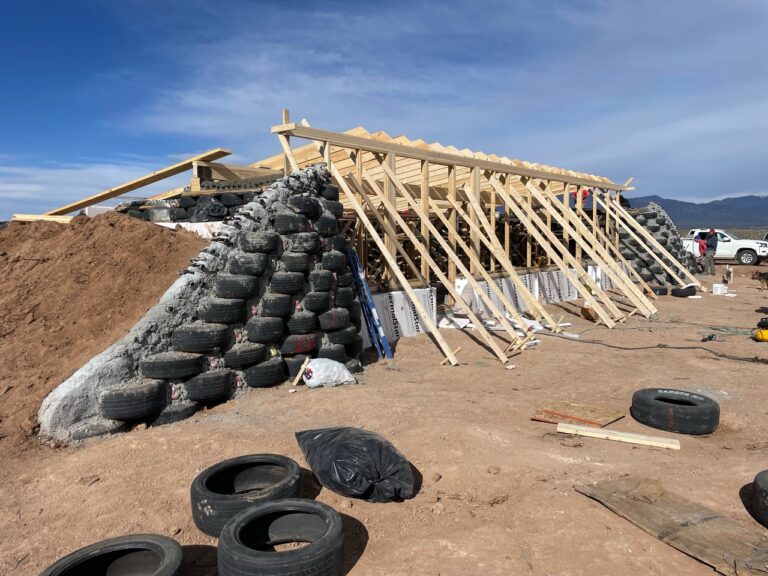
MR: Our buildings are built structurally and primarily out of automobile tires rammed with earth. Automobile tires, from my observation, are indigenous to the entire planet now. We pound them with dirt in dry climates and pound them with gravel in wet climates. They work in every climate and take centuries to decompose.
I’m also diminishing the use of wood in my houses these days because wood rots, it burns, and termites eat it. You don’t see many modern-day buildings lasting very long. Yet, when people used to build out of stone, going back to Scotland and England and Greece, the buildings that were built centuries ago are still standing. We’re currently working on a tornado-proof earthship, which seems to be imperative these days because of how many buildings have been destroyed by tornadoes. I want to build more earthships because they’re designed in a way in which they can’t easily be destroyed. In addition to that, our buildings heat and cool themselves, make their own power, harvest their own water, and treat their own sewage. We’re talking about a certain freedom from the ways of civilization, and that’s what really needs to happen to preserve the Earth and to reduce stress on people.
MoL: In 2020, there were over 1,000 Earthship homes across 40 countries. Did you receive pushback from communities or government agencies against your sustainable designs? And if so, why do you think they resisted this concept, and how did you respond?
MR: I fought the law for a long time. I spent 75% of all my time, money, and energy fighting to build these earthships and only 25% actually doing it. It should be the other way around.
All kinds of people are looking in this direction now because they’re worried that their power will go out. Almost every day on the news, someone says, “120 million people are without power because of this storm or that.” If hackers get into the power companies or the gas companies—which they have done—then people are without power. They’re just at the mercy of it. When you own a home that works with the planet to provide all of the aspects of sustenance, you’re safe.
I spent four years in the legislature and wrote a law called the New Mexico Sustainable Testing Sites Act. I wondered, why don’t we create areas set aside in every state in every county to test housing and living methods instead of testing airplanes, automobiles, and drugs that can harm people? In the proposed law, the government would set aside codes, ordinances, rules, and regulations on specific pieces of property for the purpose of allowing sustainable and independent housing to emerge. It got passed, and Governor Bill Richardson signed it. However, the legislators had a number of caveats about it. But it is recognized, at least by some people.
Certain counties in California have been difficult, but we’ve managed in every U.S. state to make it work one way or the other. In some places, it’s more time-consuming and expensive, so I’ve done all kinds of things, working with the powers that be. After 55 years, I have developed a concept—I don’t fight anymore. Like Chief Joseph, the Native American said, “I will fight no more forever.” Nevertheless, I have to put the pill in the hamburger. I take what I know we need, “the pill,” and I wrap it in the hamburger of conventionality. It’s deceiving, but I don’t try to argue with people. I am going to put the pill in their hamburger.
MoL: In 2007, you released a documentary about your experience establishing Earthships called “Garbage Warrior.” Tell us more about the documentary and how it was received.
MR: A very talented filmmaker, Oliver Hodge, saw an opportunity to create a documentary about our projects. He followed me around for three years and documented what I was doing. Garbage Warrior is what he came up with. It was well received, and won many awards. I was at many screenings of it in different cities, including Vancouver and Edinburgh, and experienced standing ovations everywhere. Now, Hodge is talking about a sequel to it because there’s just so much more the world needs to know.
MoL: Earthship Academy is a vital educational branch of your company. Why and how did you start it? What are the academy’s goals, and what do you see for its future?
MR: The Academy started because architectural and environmental students began coming to look and watch what we were doing, so we made an intern program that turned into seminars and that turned into the Academy. It takes a lot of energy, so we’re trying to make it more integral with our work, which has been very successful. What we’re doing now is a new program called Earthship Backstage. We’re putting everything—all drawings, writings, books, videos, and animations—on our website so people can have an archive of our entire history.
MoL: The refuge models seem well adapted to extreme weather conditions. How has the issue of climate change inspired your designs?
MR: I suspected significant climate change back in the early seventies, and it has happened. If you know the history of Henry Ford and the Model T, you know he experimented with various models. After 55 years of experimenting, I have my Model T—the refuge earthship. I build these refuge and tornado-resistant models for rent or sale, so millions of people have homes where they don’t have to pay for utility, water, gas, electric bills, and are warm in the winter.
Every year, people in Taos County, New Mexico, start gearing up for the winter because they need heat. It’s like medieval times. Almost all people can’t afford to heat their homes. It hit home for me nearly every week when we had the COVID winter, and people were waiting in line for food and water. Rich people were taking their kids out to their car to keep them warm because the power was off from storms. During all that time, I was walking up and down my hallway, barefoot, totally warm, harvesting tomatoes, and drinking water. I was okay.
These homes are life-changing and last longer. We must adapt, and these buildings give us the vehicle we can adapt with.
MoL: Over the course of your 55-year career in architecture, what designs and projects are you most proud of and why?
MR: Whatever I’m working on right now is usually the thing that I’m most psyched about. The refuge earthship is the culmination of everything, my baby, and along with it, is the tornado-resistant version. It’s taken us decades to learn how to create these projects—there was nobody to tell us how. We had to learn the hard way, through trial and error. Learning how to create and build them was one thing, but knowing how to make them affordable, navigate the codes, rules, and regulations was a whole other challenge. If we could deregulate housing, it would be a lot easier for more sustainable housing to emerge. The rules and regulations just get worse and worse every year. They’re 75% of the reason that affordable housing is so hard to come by.
MoL: What advice do you have for the next generation of sustainable architects?
MR: I advise them not to get caught up in the current dogma. It’s so oppressive. If you think outside of the box for a second, you are slammed down. Escape conventionality in every way, live differently.
Photography courtesy of Michael Reynolds
A pioneer in Passive House design.
Championing architecture’s potential to create an equitable and sustainable future.

Watson is dedicated to integrating indigenous knowledge into urban design and architecture to build a more sustainable and ethical future.
Steven Peck is dedicated to creating greener, healthier & resilient cities with nature & urban agriculture.